I have used Microsoft OneNote as my daily journal and scratch pad for almost twenty years. It has...
Present Tense Partners series, Part 2
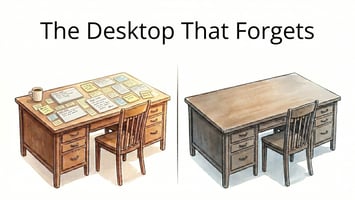
(New to the series? Read Part 1 first: The Desktop That Forgets )
A few sessions in, the worker doesn't feel so strange anymore. You've stopped being surprised by them and started paying attention to the desktop. Everything they remember sits on it, out in the open, and at the end of every session it clears. Their manner never changes, full desktop or empty. What's on the desktop is the whole of what they know.
A Little Early
Today you turn up a few minutes early, and the office door is already cracked open, so you let yourself in.
The worker is there ahead of you, head down, absorbed in something. The desk looks exactly the way you left it: an empty surface, edge to edge. Seems like nothing has changed.
Then they glance up, unhurried. "Oh. You're a little early," they say, with the mild surprise of someone caught mid-thought. "I was just about to prep for our session. Give me a moment. You're welcome to watch."
You'd never once thought about prep. The worker has always seemed so effortlessly sharp that it never occurred to you there was any. But here it is: a bit of quiet setup before every session, and you've never turned up early enough to catch it.
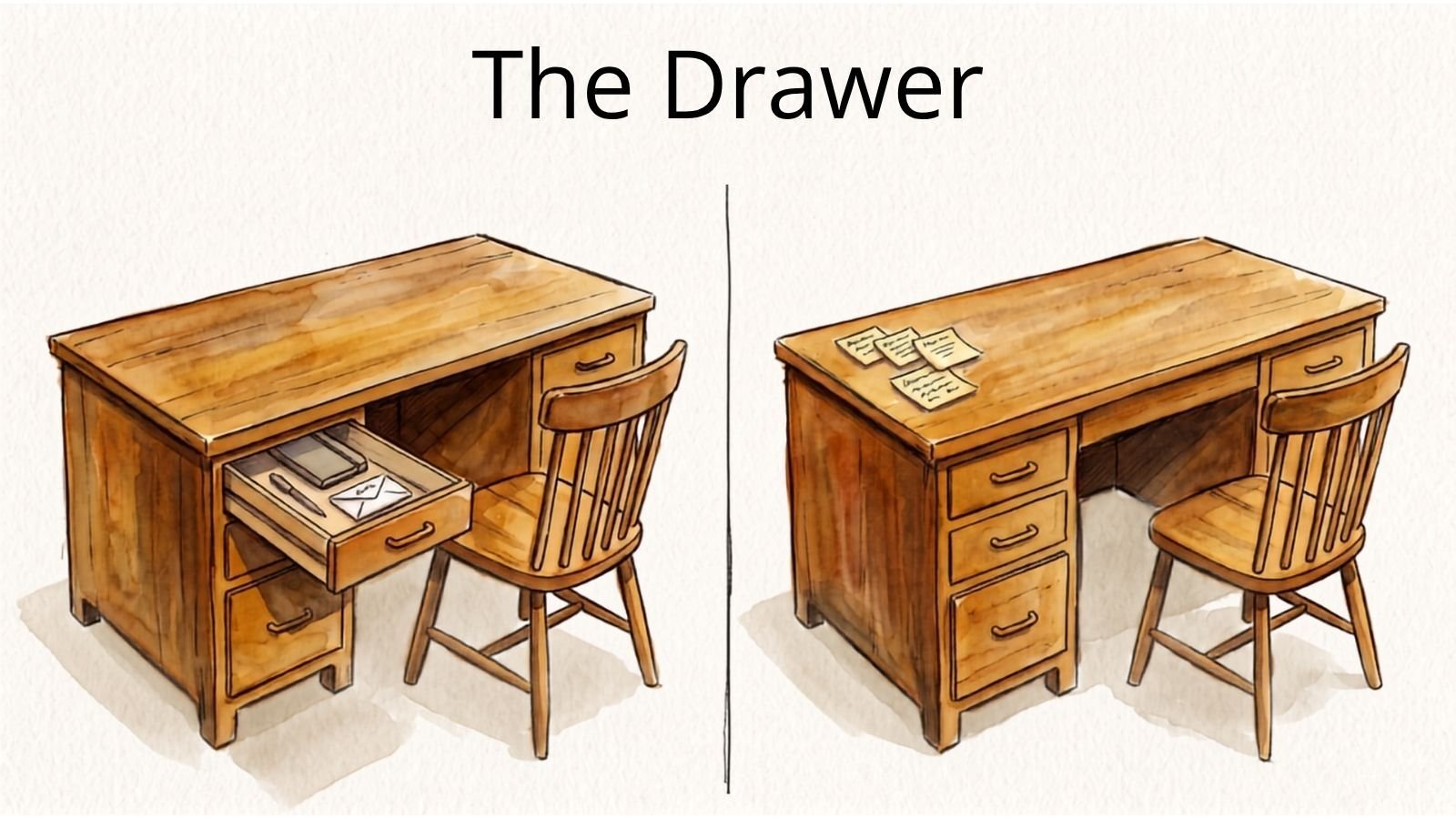
They reach down and slide open a drawer on the left side of the desk, one you've not noticed before. Inside there's almost nothing: a single pen, a slim notebook, and an envelope.
The Notebook
As they retrieve the notebook, they explain, "I started keeping some notes in here." They open it, and you notice a few lines in their own handwriting. "After that first afternoon I spent hours circling back on things you'd already decided. Observations, mostly. Things I pick up about you, and about the work we do together. Before you sit down, I copy them back onto the desktop, so we're not starting from nothing every time."
They hand it to you to see for yourself.
The entries are sparse, the system clearly new. You read:
Boss leads the team. Makes the hiring calls.
Last visit: open role. Narrowed to three must-haves. Cut the senior-level requirement. Dropped the extra credential.
You know that session the moment you see it. It was the one where the desktop cleared by afternoon, and the worker spent the rest of the day cheerfully reintroducing requirements you'd removed that morning.
And yet here it all is. The key parts of the decision, waiting on the page.
Seems to want the recommendation first, reasoning after.
You nod. They've got that one right.
Prefers a formal, careful tone in writing.
Wait, that's not accurate.
"Actually," you say, looking up, "that one's backwards. I want the opposite. Direct. Less hedging."
Not the least bit defensive, the worker takes the notebook back, draws a line through the entry, and notes the correction underneath. "Good to know," they say. "You can ask me to read this whenever you like. Fix anything that's off, tell me to add something, or have me strike an entry out completely, and it's gone for good."
Then they copy two of the entries onto a couple of sticky notes and set them on the desktop: the hiring notes on one, your corrected preference on the other. The notebook goes back into the drawer.
The desktop is no longer empty. Two sticky notes are stuck to the front corner, nearest you.
The Envelope
This makes you curious. You'd like to make some notes of your own, so you ask, "Can I put something in there myself?"
The worker considers it, then sets down the pen. "The notebook is mine," they say. "It's my read on you, and I keep it as honest as I can."
Then they reach into the drawer and bring out the envelope. Your name is on the front. Inside is a single blank card.
"But this card is yours," they say, holding it out. "You write down how you want me to work, in your own words. Every session, before we get started, I'll copy it onto sticky notes and put them up beside my own. Think of them as standing instructions: they stay on the desktop the whole time we work."
You think back to that first afternoon the desktop cleared on you, when the worker kept missing rules you'd spelled out an hour earlier. A few clear rules, written down once, would have saved all of it.
So you take the pen and jot down some guidelines:
Lead with the recommendation, then the reasoning.
Don't reopen decisions we've closed unless I ask.
Push back when you disagree. You're a thinking partner, not a cheerleader.
Flag the risks you see: especially legal, security, and cost.
The worker reads them over, nods once, and copies the card onto fresh sticky notes, pressing them onto the desktop beside their own. Then the card goes back into its envelope, and the envelope back into the drawer.
Two things live in that drawer. One they keep about you. One you keep for them.
The Full Desktop
Most days you don't come early. You walk in on time to a desktop that's already set: the worker's notes about you and your own standing instructions, holding the near corner before you've said a word.
Today you've got a real decision in front of you: a vendor shortlist, three contracts to weigh side by side.
You settle in and get going. The rhythm is the familiar one. You talk, the worker writes. A question, a note. An answer, another note.
But this time something is different. That cluster of sticky notes in the corner does not move. Today's new working scribbles crowd in behind it, and the earliest ones get nudged toward the far edge. One or two slip off onto the floor, sooner than they did on your very first visit, when the desktop was bare and the whole surface was yours.
Near the end, the worker pauses. "Remind me which vendor you wanted to rule out on price?" You'd told them that near the start, one of the first things you clarified. On an earlier visit it would still be sitting right there on the desktop. Today it slipped off the edge while the standing notes kept their spot up front. You say it again, a fresh note goes down, and the work moves on. But this time you feel it: something important you'd said, and the desktop no longer held it.
You finish the shortlist, and it's genuinely good work. But you see it plainly now: the head start from the drawer and the day's work, sharing one desktop.
Stocking the Drawer
So there's a trade to make. Everything in the drawer goes up on the desktop before you begin. The more you keep there, the more your assistant knows the moment you start, and the less open desktop is left for today's work. A few standing notes won't crowd you. But a drawer filled with rules and supporting info quietly eats into the room on the desktop long before you even get started.
But an empty drawer has its own cost. Keep it bare and you're explaining yourself all over again every session. So it comes down to choosing what earns a permanent spot up front: the preferences that actually matter, the decisions you don't want reopened, the handful of rules that make the work better.
The best desktop isn't the emptiest one or the fullest one. It's the one you set on purpose.
The Bigger Picture
Step back from the office for a moment, because almost everything in it stands for something real.
The desktop, the clear surface of the desk, is the context window: everything your assistant can see right now. It has a limited size, and when a conversation runs long, old things get crowded out to make room for new ones.
The drawer stands for the ways AI tools have started to solve this memory problem.
The notebook is the memory the assistant keeps about you between chats, the kind you can usually read, correct, or clear. It's the assistant's best guess, and it can be wrong.
The card in the envelope is a different thing. It's your standing instructions, set once in your own words and applied every time, not a guess at all.
Different tools name these things differently. The notebook is like the memory feature in ChatGPT and Claude. The card is like custom instructions in ChatGPT, or a project's instructions in Claude.
And here's the part worth holding onto. Remember those notes that slid onto the floor? They're still in your chat history. You can scroll up and read them word for word. The assistant can't. Once something falls off the desktop, it's gone from what the assistant sees, even while it's sitting right there on your screen. You can always put it back by repeating it or pasting it in. A few newer assistants are starting to go looking for what fell off on their own, but don't count on it yet.
What the Drawer Can't Hold
On your next visit you are ready to finalize the vendor decision. You mention the revised pricing sheet that landed yesterday. The worker stops. They don't have it. Not because the desktop is full, and not because it fell out of the notebook. It's sitting in your email. But your email isn't in this room, and you didn't bring a copy of the sheet with you.
This gives you an idea. "We work together all the time. Is there a way for me to share my inbox with you?"
The worker smiles and points to the wall behind the desk, where a number of brass tubes run up into the ceiling. You'd always taken them for old plumbing. "Through these I can send off for something, and have it come back to me. But we haven't connected one to your inbox yet."
What you need to give the worker next isn't in their head, isn't on the desktop, and isn't in the drawer. No tube runs to it yet. And that's a different problem entirely.
Next time, we'll explore those tubes.
Why I wrote this:
Most of the teams I advise are trying to get AI into the real work, past the tinkering. What trips people up first is rarely the advanced stuff. Often they don't share a clear mental model of how AI actually works, so one person gets great results while someone two desks over fights the tool all day.
I wrote this series because that shared model pays off fast, and an allegory is the quickest way I've found to hand it to a whole team at once. Each post walks through one piece of it.
I'm Scott Heffield. I help teams that build software products use AI to build better, not just faster.